
Audience measurement without personal data
Whether in front of a screen, at a store entrance or in a store zone, RVC.DIGITAL counts people, measures attention and estimates age and gender — entirely on the device. No image leaves it, no face is recognised, and an independent data protection assessment concluded that the system falls outside the scope of the GDPR.
Images never leave the device.
Every frame is analysed in the device memory and discarded. No video, no still image is recorded.
No face recognition.
The system detects that a face is present; it never creates or compares a facial template.
No biometric data.
Because no template exists, no special-category data under Article 9 GDPR is processed.
Stored in the EU.
Measurement results are kept on the RVC.DIGITAL platform in data centres within the European Union.
Independently assessed.
A data protection impact assessment by an independent auditor in November 2024 concluded the system does not process personal data.
How a measurement happens
The principle is the same whether the camera measures the audience of a screen, footfall at a store entrance, a checkout queue or a shelf.
The camera streams to a small measuring device next to it.
AI models detect people, whether they look towards the screen, and estimate age group and gender; in store analytics they count entries, measure queues or check shelf state. All of it in memory, in real time.
The frame is discarded. What remains is a set of numeric results: counts, seconds, an age band, a gender estimate, a zone or shelf status, a timestamp.
Only these numbers travel to the RVC.DIGITAL platform in the EU, where the dashboard aggregates them into statistics.
At no point does an image, a face crop or a facial feature leave the device.
What leaves the device — and what never does
- Passers-by or visitors (people detected in view)
- Impressions (people who faced the screen)
- Attention / reach (looked longer than a set threshold)
- Dwell time and watch time (seconds)
- Direction of movement, entries and exits (where configured)
- Age group (estimated band)
- Gender (estimate)
- Store analytics where configured: zone counts, queue length, shelf status
- Timestamp and device ID
- Video
- Still images
- Face crops
- Facial templates or embeddings
- Any identifier that persists beyond the detection
Each detection produces one record with a temporary tracking number that is valid only while the person is in view, so that a person is counted once. The number is discarded shortly after they leave the frame; the system cannot link a person across visits, days, cameras or locations.
Face detection is not face recognition
Face detection answers one question: is there a face in the frame, and is it turned towards the screen? That is what RVC.DIGITAL uses to measure attention and to estimate age group and gender. Face recognition would answer a different question — who is this person, or have we seen them before? RVC.DIGITAL does not do that. It does not create, store or compare facial templates, cannot identify anyone and cannot recognise a returning shopper or passer-by.
Where your data lives, and who can see it
Location.
Measurement data is stored on the RVC.DIGITAL platform, in data centres within the European Union.
Retention.
The stored data is anonymous statistical data, so GDPR retention limits for personal data do not apply. It is kept for the duration of the service contract to support reporting and period-on-period comparison, and deleted at the customer's written request after the contract ends.
Access.
You see the dashboard and reports for your own devices, and event-level data through the API or a webhook where contracted. IRF Solutions has technical access for operation, support and product development, limited to named staff with individual accounts and role-based permissions. Hardware manufacturers have no access. Measurement data is not sold, shared or transferred to anyone else.
Independently assessed
An independent data protection impact assessment (DPIA, Article 35 GDPR) of RVC.DIGITAL was carried out by an independent data protection auditor in November 2024. Its conclusion: the system does not process personal data, and its operation therefore falls outside the scope of the GDPR. The Data Protection Fact Sheet, which describes exactly what the device outputs and where the data goes, is available on request.
What remains your responsibility
RVC.DIGITAL is designed so that no personal data is processed. As the operator of the site or store, you remain responsible for your own obligations — for example informing the public about the measurement where local law or practice requires it. Measurement zones are set to the screen, entrance or area being measured rather than to staff areas; we agree the camera placement with you during the pilot.
Frequently asked questions
Does the system record video?
Can it recognise a returning shopper or passer-by?
Is RVC.DIGITAL GDPR compliant?
Do we need our own DPIA?
Where is the data stored?
Can the system be used to monitor employees?
Does this apply to in-store use as well as outdoor screens?
Does vehicle measurement read number plates?
Related stories

Retail media in hypermarket chains
Hypermarket chains measure the audience of their in-store screens with RVC.DIGITAL and report it to their advertisers — by store and time slot, in post-campaign reports.

Campaign measurement at Budapest's busiest tram stops
One-month campaign measurements on citylights where pedestrian volume can exceed tens of thousands a day.
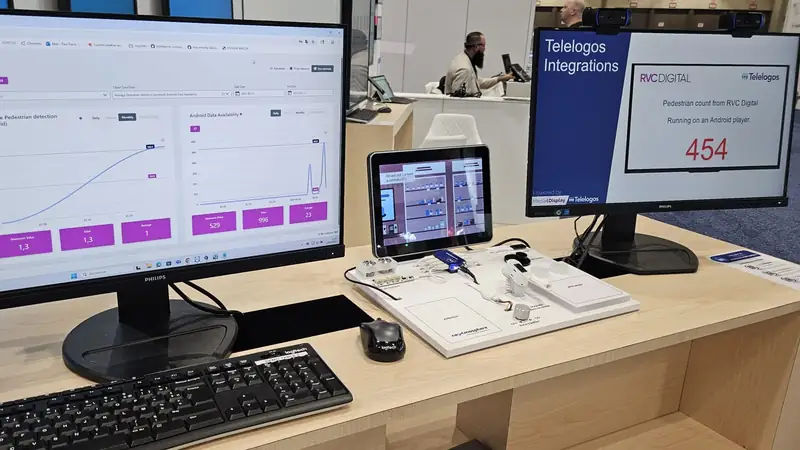
Audience data inside Telelogos Media4Display
RVC.DIGITAL is a member of the Telelogos Software Partner Network. Measured audience data flows into the Media4Display CMS, where it can drive content rules. Shown live by Telelogos at InfoComm 2025 — on an Android player.