

Retail media, measured at the screen
In-store screens sell real advertising. RVC.DIGITAL tells you, per screen and per time slot, how many shoppers passed, how many looked, for how long and in which age and gender segments — and can pass that signal to your CMS, so the right campaign plays in front of the right shoppers. No face is recognised, nothing is recorded.
The same loop, morning to night
Most retail media networks play one fixed content loop from opening to closing — regardless of who is actually standing in front of the screen. The morning's older shoppers and the afternoon's families see exactly the same message, so a large share of impressions runs into the void. And when an advertiser asks what their money bought, the answer is usually store footfall from the door counter — which says nothing about who was at the screen, or whether anyone looked.
What you get
Proof per screen.
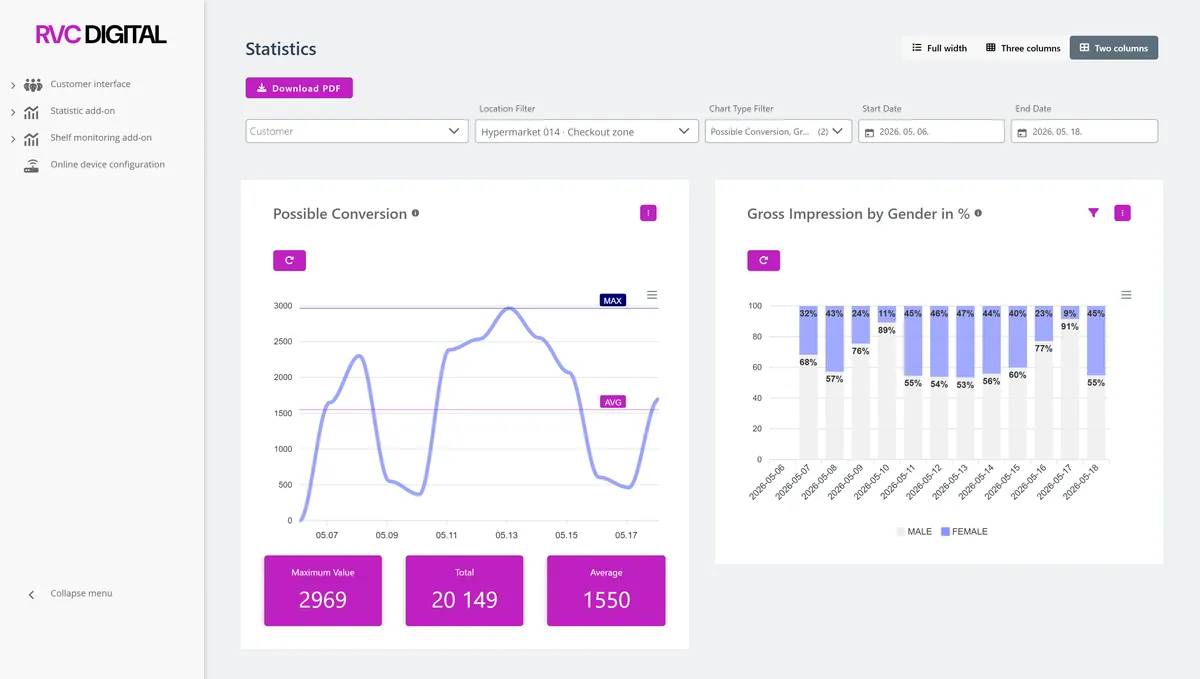
How many shoppers passed each screen, how many turned towards it, how long they looked, and the age and gender mix — by hour, by day, by store.
Reports your advertisers accept.
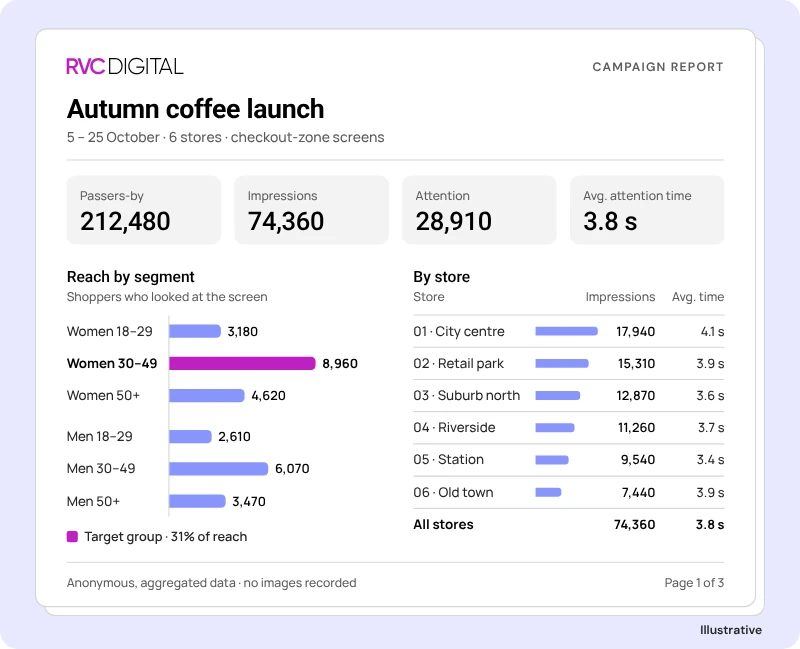
Post-campaign reach per segment and attention time for each campaign, exportable, comparable across stores. Measured, not assumed.
Audience-aware content (optional).
A real-time, anonymous audience signal to your CMS, so the content mix follows who is in the store — gradually, by time slot, never per person.
What we measure at the screen
All of it on anonymous, aggregated data: the device never recognises a face and never records an image. Privacy & compliance →
- Passers-by — shoppers who passed the screen (possible conversion)
- Impressions — shoppers who turned towards the screen
- Attention — shoppers who looked longer than a set threshold
- Average attention and watch time (seconds)
- Age group and gender distribution — aggregated, per time slot
- Hourly and daily breakdown, any date range
- Store-to-store and screen-to-screen comparison
- CSV export and API or webhook access
Audience-aware content — the CMS keeps control
The next step for a retail media network is content that follows the audience. Not reacting to a single shopper, and not switching in a flash: the system works from the aggregated audience picture of the last few minutes and shifts the content mix gradually. Mornings lean towards older shoppers; after school, students see something relevant to them — not the same loop.
The device estimates the age and gender composition of the audience in front of the zone, locally, with no recording and no face recognition.
That composition is passed to your CMS as a structured signal over a webhook or API. A clean input, not a command.
Your own rules decide which creatives move up and by how much. Content, weights and campaign priorities stay in your system; RVC.DIGITAL adds the signal.
Dynamic, not instant
The signal is smoothed over a sliding window, bound to thresholds, and the switching cadence is tunable. A single passer-by can never destabilise the screen, and every campaign receives a stable, measurable share of screen in front of its own target audience.
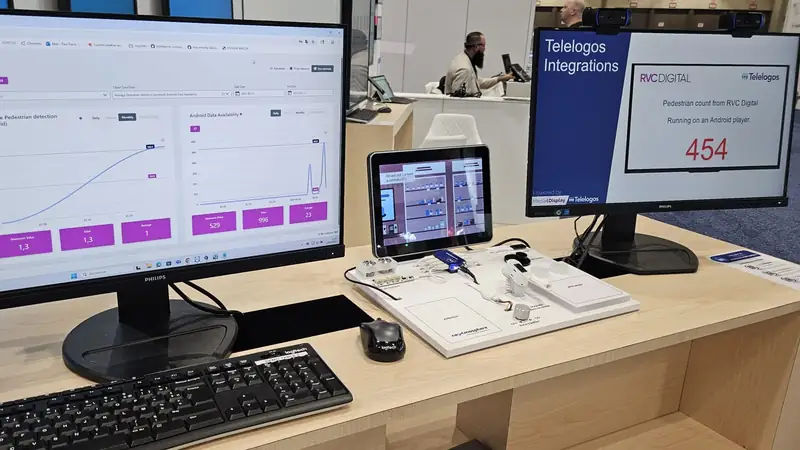
RVC.DIGITAL integrates with Telelogos Media4Display (we are a member of the Telelogos Software Partner Network) and Wallboard; any CMS that can receive a webhook or call an API can consume the same signal.
Proof after the campaign
The same sensor that can drive content also measures what the screen actually delivered: reach per segment, dwell and attention time, by store and time slot. On the RVC.DIGITAL dashboard these become reports that show, after the fact, whether a creative reached the audience it was bought for. Every advertiser gets proportional visibility in front of its own target group — and a report to prove it.
Built for how stores actually work
Its own connection.
Each device runs on its own 4G link. It does not touch your store network — no access, no exposure, nothing for IT to approve.
Plug and play.
Devices arrive pre-installed and ready to run. On site you need a power socket and a place for the camera; placement is agreed during the pilot.
Minimal hardware.
A small mini PC and a USB camera, or an existing RTSP camera stream. Linux, Windows or Android — it runs on entry-level Android signage players as well.
From a few screens to a chain.
The same setup scales from a handful of checkout-zone screens to a network across all stores, with store-level and network-level reporting.
Or built into the display: digital totems are available with the camera and RVC.DIGITAL already on board, installed as a single unit.
Built by a software company, adapted to your network
RVC.DIGITAL is a product, not a project — but it was built by a team that has written enterprise software for 25 years. Your own age bands and thresholds, a trigger cadence tuned to your network, reports in the format your advertisers already use, integration into your CMS or BI, or a measurement nobody offers yet — a checkout-queue timer and a shelf monitor both started as one customer's request. Tell us what you need, and we build it into your deployment.
Shoppers are counted, never identified
In use in hypermarket retail media networks
Hypermarket chains run RVC.DIGITAL across their in-store retail media networks to report the measured audience of their screens to their advertisers — by store and by time slot.
Start with a pilot, not a contract
A pilot runs in one to five stores with one to five devices for two to four weeks. We agree the screens and camera placement with you, install pre-configured devices, and close with a report: audience per screen and time slot, attention, segments, and — if you choose — a first look at how a CMS trigger would behave on your network. You decide what comes next.
Frequently asked questions
Does it work with our CMS?
Do we need to connect it to our store network?
Can it tell us which campaign increased sales?
Does it recognise shoppers or build profiles?
Can we use our existing cameras?
Can it also measure store footfall, queues or shelves?
Related stories

Retail media in hypermarket chains
Hypermarket chains measure the audience of their in-store screens with RVC.DIGITAL and report it to their advertisers — by store and time slot, in post-campaign reports.
Audience data inside Telelogos Media4Display
RVC.DIGITAL is a member of the Telelogos Software Partner Network. Measured audience data flows into the Media4Display CMS, where it can drive content rules. Shown live by Telelogos at InfoComm 2025 — on an Android player.
See your own screens measured.
A two-to-four-week pilot in a few stores, closed with a report you can show your advertisers.