
How RVC.DIGITAL works
A camera on site, a small device that analyses the input locally and keeps only numbers, an EU-hosted dashboard, and an API and webhook into your own systems. Delivered as a ready-to-use device or as a container for your hardware. No GPU, no video, no vendor lock-in on your data.
From sensor to signal
A USB camera or your existing RTSP camera stream; a GPS unit for vehicles on routes.
The RVC.DIGITAL software analyses every frame in memory and discards it. What leaves the device is numbers: counts, seconds, age bands, gender estimates, vehicle types, zone and shelf states.
The numbers arrive over an encrypted connection at the RVC.DIGITAL platform, hosted in the EU: dashboard, reports, device and user management.
The same data flows on through a REST API and webhooks into your CMS, SSP, BI or reporting stack.


Two ways to deploy
Ready-to-use device
For media owners and retailers. A pre-configured mini PC with camera, optionally on its own 4G link, so it never touches your network. Power it, place the camera, done; placement is agreed in the pilot.
Container for your hardware
For integrators and signage providers. The same software as a container on your Linux or Windows device, or the Lite edition on an Android signage player. As a rule of thumb, one low-cost mini PC per camera stream; processing runs on the CPU, no GPU required.
Linux, Windows or Android
Linux
Full feature set, the standard for new deployments.
Windows
Standard feature set, for existing Windows-based players and PCs.
Android (RVC.DIGITAL Lite)
Entry-level edition for Android signage players: people counting and basic metrics, as shown by Telelogos at InfoComm 2025.
Minimum hardware
- Intel N100-class CPU or better
- 4 GB RAM
- 6 GB storage
- Internet access (low traffic)
- USB camera or RTSP stream
No GPU, no server on site. The device is the size of a paperback.
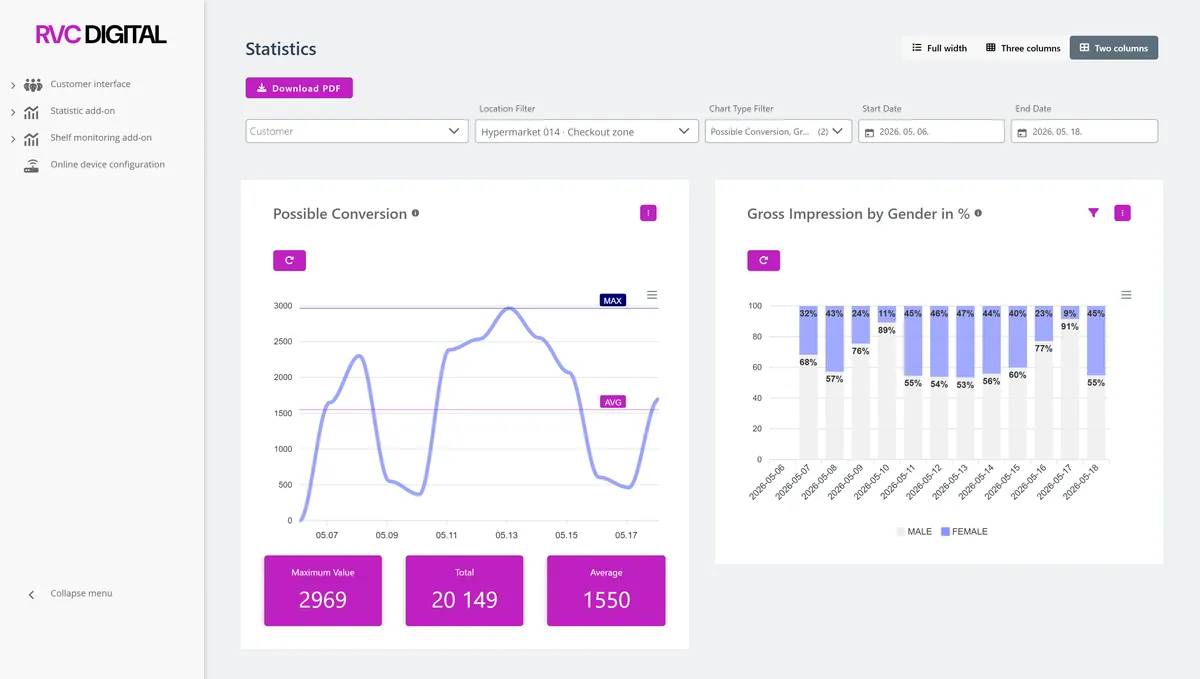
Dashboard and reports
- Measuring-point map and device management
- Hourly and daily breakdown, any date range
- Site-to-site, store-to-store and campaign comparison
- Age and gender distribution, aggregated
- CSV export
- Customer, partner and user management — distributors manage their own customers and devices in one place
- Campaign reports as PDF (transit module)
Your data, in your systems
Everything the dashboard shows is available to your own systems. A webhook pushes events as they happen — a count threshold reached, an audience mix for the current time slot, a shelf position gone empty. A REST API lets your CMS, SSP or BI pull data on demand. Each customer has its own API token; all traffic is encrypted. Integrations in use today: Telelogos Media4Display (RVC.DIGITAL is a member of the Telelogos Software Partner Network) and Wallboard. Any platform that can receive a webhook or call an API can consume the same signal.

Three packages, one platform
Insights
- Linux, Windows or Android
- device, customer and user management
- measuring-point map and dashboard
- passers-by (OTS), impressions, reach, dwell time, engagement
Premium Measurement
- everything in Insights, on Linux or Windows
- age and gender
- vehicle counting incl. bikes and motorcycles
- data endpoint / API
Advanced Programmatic
- everything in Premium
- direction of movement
- ad triggering via webhook
- comparative measurement
- reports and export
Shelf availability monitoring, store heatmaps and traffic & vehicle analytics are delivered as individually scoped projects, priced per deployment.
Pricing on request — see Pilot & packages →
Configured to your network — or built for it
RVC.DIGITAL is a product. Most of what a network needs is configuration, not code: measurement zones, thresholds, age bands, trigger cadence, report formats, alert rules. Where configuration is not enough, the team that wrote the product builds the rest — into your deployment, not as a side project.
- zones and measurement areas
- attention thresholds
- age bands
- trigger smoothing window and cadence
- alert rules and recipients
- report layouts and schedules
- user roles for customers and partners
- new measurements (a shelf monitor and a checkout-queue timer both started as one customer's request)
- custom metrics such as vehicle brand or weather-dependent reach
- traffic-flow signals for roadside screens
- integrations into a sales, traffic or BI system
- a white-label dashboard for partners
Built by IRF Solutions, a Budapest- and Vienna-based software company with 25 years of enterprise systems behind it. About →
Numbers leave the device. Images never do.
Frequently asked questions
Device or container — which one do we need?
Can we use our existing cameras?
How many cameras per device?
How do we get the data out?
Does it work with our CMS?
We are a distributor or integrator — can we manage several customers?
What runs on Android?
Is there a GPU or a server on site?
Related stories
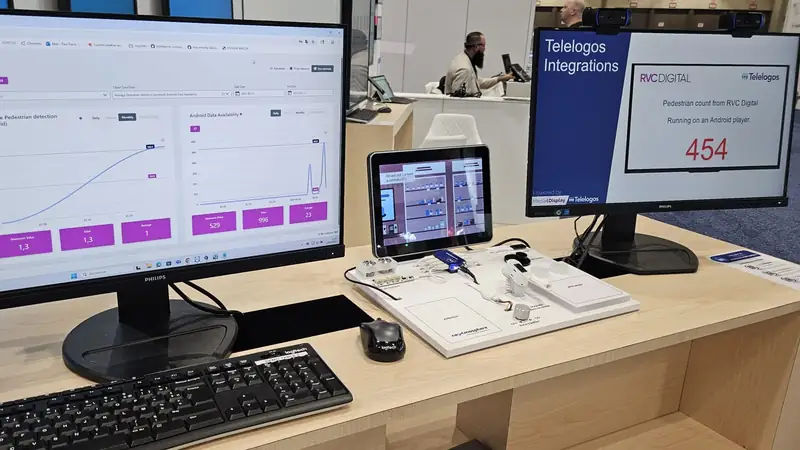
Audience data inside Telelogos Media4Display
RVC.DIGITAL is a member of the Telelogos Software Partner Network. Measured audience data flows into the Media4Display CMS, where it can drive content rules. Shown live by Telelogos at InfoComm 2025 — on an Android player.

RVC.DIGITAL audience data in Wallboard
Audience counts and signals from RVC.DIGITAL are available to Wallboard content rules through a webhook and an API.
Read the story →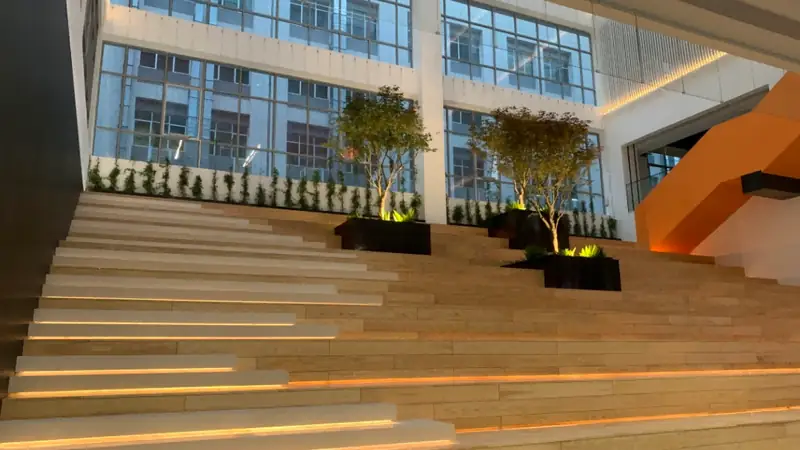
Interactive audience measurement at the Absen LED wall in Huizhou
At Absen's manufacturing centre in Huizhou an LED wall shows its own audience: every viewer appears as a bee on the screen while presence and dwell time are measured.